
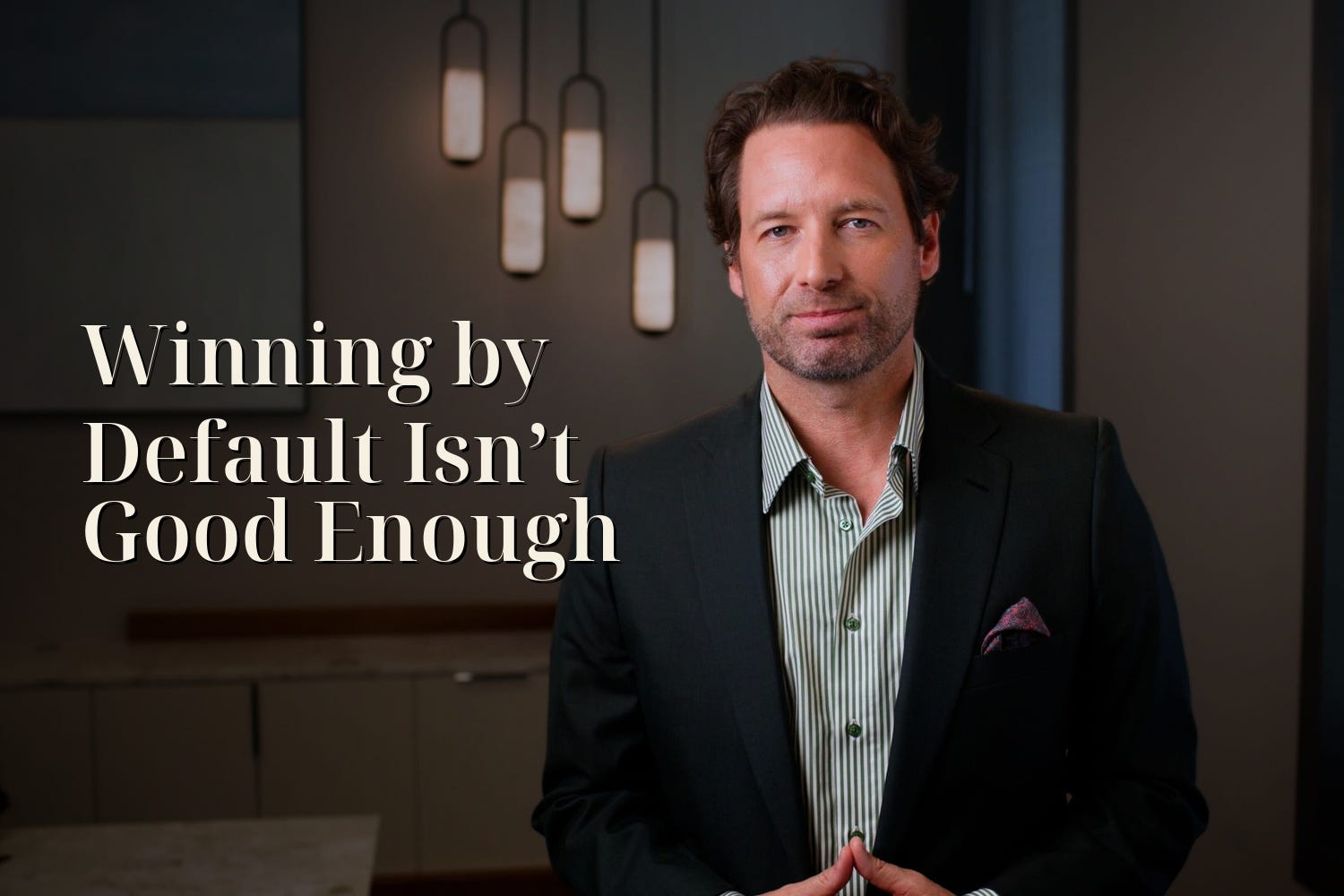
Winning by Default Isn’t Good Enough
It's time to make serious changes to the Democratic Party before 2028

Democrats are likely to have a very good November.
And we should.
A Fox News poll released recently showed Democrats leading Republicans on the generic House ballot, 52% to 46%. The same poll found Democrats with advantages on the economy, inflation, and health care, while Republicans still led on immigration, border security, crime, and national security. That is the whole opportunity and the whole warning in one poll. Voters are open to Democrats. They are also still not sold on Democrats where we have some of the biggest trust gaps.
Republicans are giving voters plenty of reasons to put a check on this presidency and stop the MAGA movement in its tracks. Trump’s numbers are bad. Reuters/Ipsos found last week that only about one in four Americans approve of his handling of inflation and rising prices. Fox found deep economic pessimism, with about three-quarters of voters rating the economy negatively and 70% saying it feels like the economy is getting worse.
That is a real opening.
But Democrats should be careful about what lesson we take from a good political environment.
If voters support Democrats because they are angry at Republicans, that helps in November. It does not mean voters trust Democrats again. It does not mean the party’s brand is fixed. It does not mean people are buying what we’re selling. It may simply mean they are rejecting the other side.
A backlash can win an election.
Trust builds a majority.
That difference matters.
For too long, Democrats have treated Republican failure like our own achievement. Trump says something insane, and we assume voters will come running to us. MAGA produces more chaos, and we think the contrast is enough. Republicans nominate another extremist, and we act like our work is done.
It isn’t.
People know Donald Trump. They cannot escape him. They know the chaos, the cruelty, the corruption, the fealty, the circus. Voters see what today’s Republican leadership has become, and they are sick of it.
The harder question is what they think of us.
And the data is not flattering.
Pew found last fall that 75% of Americans say the Democratic Party makes them feel frustrated. Only 28% said the party makes them feel hopeful. Only 16% said it makes them feel proud. Pew also found that 57% of Americans describe Democrats as too extreme, while 61% say the same of Republicans. That is not the profile of a party voters are excited to run toward.
Gallup found that a record-high 45% of Americans identified as independents in 2025, while Democrats and Republicans were each at 27%. Nearly half the country is looking at the two major parties and saying, in one way or another, “I’m not one of you.” Democrats should hear that as a warning, not a footnote.
Even Democrats are frustrated with Democrats. AP-NORC found last summer that 35% of Democrats used negative words to describe their own party, compared with only 23% who used positive words. Fourteen percent described the party as weak or tepid, and 9% called it broken or ineffective. A later AP-NORC poll found that only about seven in ten Democrats had a positive view of their own party, and that Democratic favorability inside the party still had not bounced back after 2024.
Young voters tell the same story. Harvard’s Fall 2025 Youth Poll found that 58% of young Americans used a negative word to describe Democrats, with “weak” the most common descriptor. Among young men, 64% used a negative word for Democrats. But that same poll also found Democrats leading young men on preferred control of Congress, 43% to 31%. That means these voters are not gone. They are gettable. They are also unconvinced.
That distinction should shape everything Democrats do.
Voters are not confused about Democrats.
They are unconvinced.
A lot of Democrats hear that critique and immediately want to argue with it. They want to say voters are misinformed. Or manipulated. Or watching the wrong channel. Or failing to understand the nuance.
Sometimes that is true. Misinformation is real. Right-wing media is powerful. Social media has made everything worse.
But we should be honest enough to admit the rest of the truth: voters have been telling us something for years, and we have been too slow to hear it.
Too many voters look at Democrats and see a party that feels preachy, judgmental, weak, too managed, too online, too afraid to say obvious things, and too disconnected from the way people actually live.
That may not be how Democrats see ourselves. But politics is decided by how voters experience us.
And right now, too many voters experience Democrats as a party that lectures more than it listens, corrects more than it connects, and makes itself harder to join than it needs to be.
That is a problem we cannot explain away.
Another consultant memo will not fix it. Another post-election autopsy that everyone pretends to read will not fix it. Another round of “voters just don’t understand us” will not fix it.
The party has to change how it talks, how it listens, how it chooses fights, how it treats candidates, and how it makes people feel when they consider joining the coalition.
Democrats have made the party too hard to join and too easy to make fun of. That is a brutal combination.
A political party should feel like an open door. Too often, ours feels like a velvet rope.
Use the right language. Signal the right things. Agree with the right groups. Avoid the wrong questions. Say the approved phrase. Don’t offend the wrong faction. Don’t ask too many questions about the latest cultural fight.
That is no way to build a majority.
A party that wants to win back working people should not sound like it was built in a consultant retreat. A party that wants to speak for ordinary families should not make ordinary people feel like they need a glossary or a permission slip before they are welcome. A party that claims to care about democracy should not be terrified of disagreement inside its own coalition.
The Democratic Party should be big enough for people who do not talk like professional Democrats.
It should be big enough for men who feel like the party only talks about them when someone is blaming them for something.
It should be big enough for voters of faith who are tired of seeing religion turned into grievance and performance art.
It should be big enough for working-class voters who want to hear less jargon and more common sense.
It should be big enough for rural voters who know when a party has already written them off.
It should be big enough for Black and Latino voters who care about civil rights and voting rights, but also care about jobs, schools, safety, faith, housing, health care, and the price of groceries.
People are whole human beings. Democrats get in trouble when we treat them like categories in a consultant memo.
The first step back is respect.
Respect does not mean agreeing with everybody. It does not mean watering down every belief. It does not mean chasing voters by pretending to be something we are not.
Respect means listening before lecturing. It means taking voters’ concerns seriously even when those concerns make people in our own party uncomfortable. It means recognizing that persuasion is the work of politics, not a betrayal of it.
Broad appeal is the job.
That sentence should be obvious, but too often Democrats act like winning over new voters means compromising our soul. That is backwards. Winning is how you protect rights. Winning is how you pass laws. Winning is how you appoint judges. Winning is how you stop the people you say are dangerous.
A political party exists to win elections so it can govern and improve people’s lives.
Somewhere along the way, too many Democrats started treating winning like one concern among many. Internal approval mattered. Group approval mattered. Online approval mattered. Moral performance mattered. Avoiding criticism from our own side mattered.
All of those things started competing with the one thing a political party has to do before it can do anything else: win.
And when we do win, we should ask ourselves why.
Did we win because voters trust Democrats? Or did we win because Republicans went off the deep end? Did we win because our message broke through? Or because the other side collapsed? Did we win because people feel proud to vote for us? Or because they held their nose and decided we were the less dangerous option?
Those distinctions matter. A party that mistakes backlash for trust will keep making the same mistakes.
Winning one cycle because Republicans screw up badly enough may get Democrats through November. It will not build a durable majority. It will not win back voters we’ve lost for too long and keep them. It will not rebuild the party’s connection to the people who used to see Democrats as the party of work, dignity, fairness, faith, community, and opportunity.
That is the party I still believe in.
I believe in a Democratic Party that talks plainly about the cost of survival: housing, health care, childcare, insurance, prescription drugs, groceries, and the feeling that life has become too expensive and too rigged for too many families.
I believe in a Democratic Party that can talk about immigration without sounding scared of the word “border.”
I believe in a Democratic Party that can say public safety matters without sounding like it is borrowing Republican language.
I believe in a Democratic Party that can speak to men without pandering to them or blaming them by default.
I believe in a Democratic Party that can talk about faith sincerely, not awkwardly, and without ceding the entire moral vocabulary of American life to the religious right.
I believe in a Democratic Party that can say no to bad slogans, bad incentives, bad consultants, and bad internal habits that make winning harder than it should be.
And I believe in a Democratic Party that understands something simple: voters do not owe us trust because Republicans are worse.
We have to earn it.
Every cycle. Every race. Every conversation.
That is what I’m going to write about here. I’m going to say some things that may make Democrats uncomfortable. I’m going to say them because I want Democrats to win. I’m going to say them because I think the country needs a Democratic Party that is stronger, broader, more practical, more grounded, and more connected to the lives of the people it claims to fight for.
The goal is not to beat up on the party. The goal is to stop lying to ourselves before we waste another opportunity.
Democrats may win this fall. Good. We should.
But the long-term goal cannot be borrowing voters for one cycle because Republicans became intolerable. The goal has to be winning voters back and keeping them.
A backlash can win an election.
Trust builds a majority.
More government-owned housing and grocery stores, along with more transgender education in kindergarten will get Democrats straight to the victory. And don't forget taxing the rich. Tax everyone who has more money than Bernie.
First, where is consideration of women and nonbinary folks in the task of opening the arms of the party to all?
Second, although I would call the party feckless, they are really enablers by virtue of being so entrenched the the reward system that they cannot give it up. Think Schumer and his grift. Jeffries and his PAC-laundering scheme that allows congresspeople to receive money from AIPAC-adjacent PACs so they can deny taking AIPAC money. Without term limits, the rewards for staying in congress forever are too great to risk rocking the boat. The Dems are responsible for the Orange Excrescence getting elected again.